Lamborghini built 1,983 Countaches in sixteen years. The first 157 are worth nearly twice as much as any of the others, and the reason is not the one most people would guess.
An LP400, the narrow-bodied original known as the Periscopio for the rear-view periscope set into its roof, has an AutoIndex guide value of £800,000. The LP400 S that replaced it in 1978 is £420,000. The LP500 S is £450,000 and the four-valve 5000 Quattrovalvole £420,000. Three later versions, each built in larger numbers, sit between £420,000 and £450,000, and all of them a long way below the first.
It isn't age
The easy explanation is that the first of anything is worth more. The numbers don't support it. If the market were paying for age, each step down the chart would be a smaller step, and it isn't. There is one large drop, in 1978, and almost nothing after it. The market is paying for a single change, not for the passage of time.
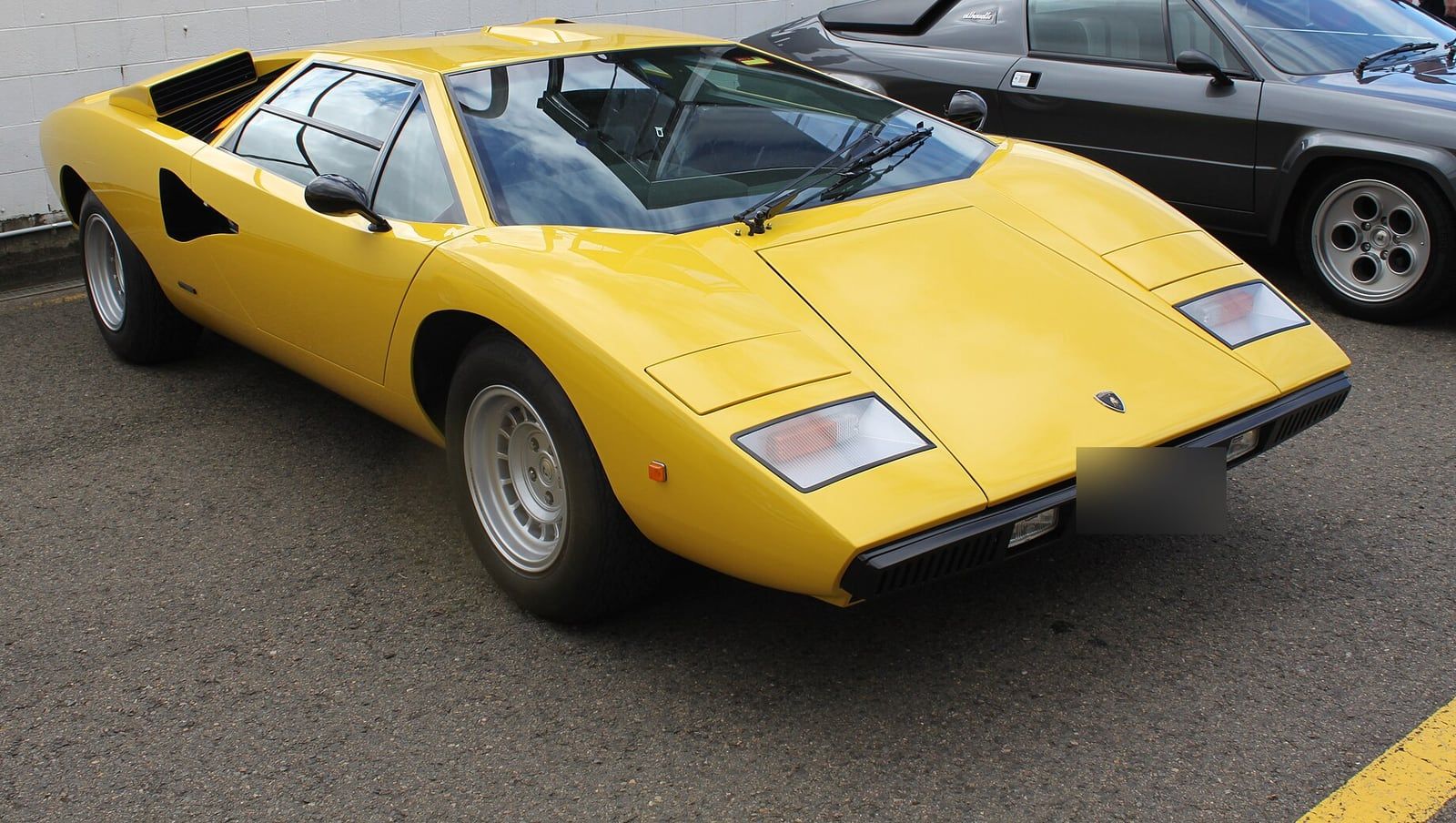
The LP400 was first offered at the 1974 Geneva show, where 50 orders were placed, and it was built until 1978. It is the purest version of the wedge: narrow wheel arches, slim wheels, no spoilers, and the roof that gave it its nickname. The periscope was a mirror looking backwards through a channel in the roof, there because the cabin, with the engine behind it, offered very little view to the rear. The view it gave was not good, and the feature did not last.
That change was the LP400 S. It brought flared wheel arches, wide Pirelli P7 tyres, revised brakes and suspension, a flat roof in place of the periscope channel, and an optional rear wing. It is the car most people picture when they hear the name: the Countach on the bedroom wall. It is also the moment Marcello Gandini's design, drawn at Bertone and first shown as the LP500 concept at Geneva in 1971, stopped being the design he drew.
One drop, in 1978
Countach guide values, October 2026. The gold bar is Gandini's original narrow body; blue bars are the flared, later cars.
Read the chart by colour rather than height. Once the arches and the wing arrived, power and engine size stopped moving the price much. The LP500 S and the Quattrovalvole are more developed cars than the LP400 S, and the market treats all three as roughly the same thing.
Within the later cars, the same rule shows up on a smaller scale. Classic & Sports Car's price guide puts the early, low-body LP400 S, the closest of the later cars to the original, above the later S3 and LP500 S. The nearer a Countach is to what Gandini drew, the more it is worth.
The market is not paying for the oldest Countach. It is paying for the last one Gandini would recognise.
Why rarity alone doesn't explain it
A hundred and fifty-seven cars is a small number, and scarcity is part of the story. It is not all of it. The first series of the LP400 S ran to only 50 cars, by the factory figures, and those cars still sell for well below an LP400. Rarity sets a floor under a price. The design is what sets the premium.
The rarest of all are the right-hand-drive Periscopios: 19 of the 157, according to Iconic Auctioneers, which offered one at Silverstone in 2025. It was the first public auction of a right-hand-drive car since 2014, which tells you how seldom the best of these come to market at all.
Auction results bear the values out. RM Sotheby's sold a 1975 LP400 in Paris in 2025 for €820,625. Classic & Sports Car's guide, published in 2022, put an average LP400 at £700,000 and a show car above £900,000, against £400,000 to £600,000 for a 5000 Quattrovalvole. The gap has been there for years, and it has held.
The case for the later cars
If you want to drive a Countach rather than own the idea of one, the later cars make a strong argument. The Quattrovalvole is the one with the noise and the presence that made the car's reputation in the 1980s, and 610 were built, more than any version except the 25th Anniversary. It costs about half as much as an LP400.
Nor is it the weaker investment by default. Every Countach on that chart is still rising in value, and on the catalogue's twelve-month figures the flared cars have lately kept pace with the original. Buying one is not a mistake. It is a different purchase with a different job.
The risk sits at the top. When a premium rests on originality, it is only as good as the proof. An LP400 is worth £800,000 because it is the original car, and a car that cannot show it is the original is not worth that, however it looks. The same thing happens on the E-Type, where two otherwise identical cars are valued far apart on paperwork alone, and on the E30 M3, whose price rests on the homologation story.
So?
If the Countach you want is the idea, Gandini's wedge as it was first drawn, the LP400 is the only version that delivers it, and the market has priced that consistently for years. If you want the poster on the wall, buy a Quattrovalvole and keep the difference.
Neither choice is wrong. The expensive mistake is paying LP400 money for a car whose history doesn't prove it is one. Telling the versions apart, and the records that separate a genuine Periscopio from a good story, are where the money is won or lost.