There is a particular kind of double-take that happens when someone who knows modern cars looks up what an E30 M3 costs. Here is a thirty-five-year-old saloon with 195bhp, no turbocharger, no carbon anything, and a 0–60 time a diesel estate would beat today. It is worth more than a new M3. In Sport Evolution form, it is worth nearly twice as much.
The instinct is to file this under nostalgia — a generation of enthusiasts bidding up the poster on their childhood wall, the way it happened to the Escort Cosworth and the Integrale. That explanation is comforting and it is mostly wrong. Nostalgia moves a car ten or twenty per cent. It does not put a saloon from 1990 above every one of its own successors, and it certainly does not hold it there for fifteen years.
Something more structural is going on, and once you see it you start seeing it everywhere in the market.
A racing car that had to be sold
The E30 M3 was not designed as a fast road car. It was designed to win the European Touring Car Championship, and Group A rules required that the thing you raced was something you also sold — 5,000 of them, in the first twelve months, to the public.
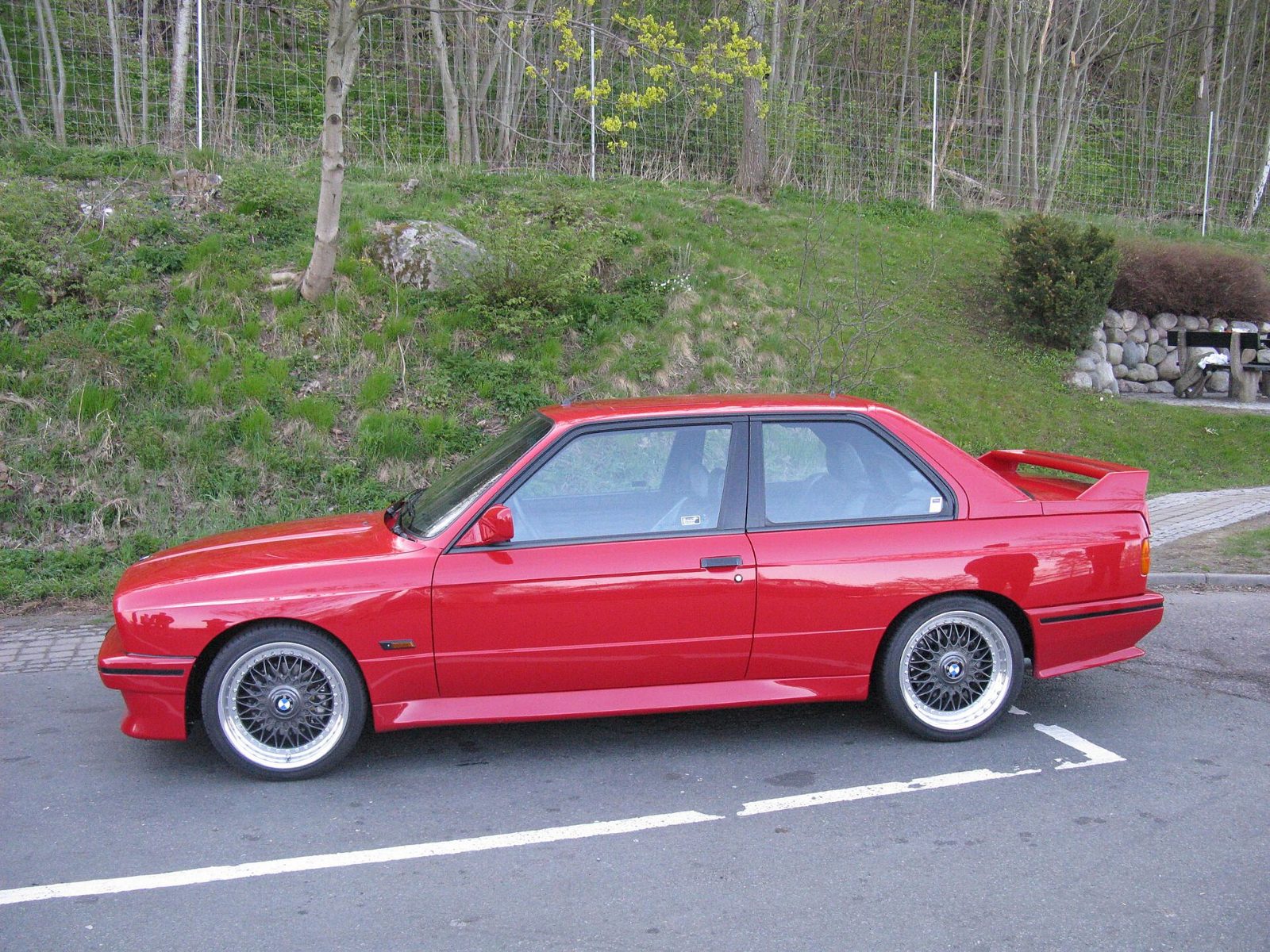
So BMW built 5,000 road cars because it had no choice. Almost every panel is different from the 3-series it resembles: the boxed arches, the raised bootlid, the shallower rear screen, all of it aerodynamic homework rather than styling. The S14 engine is a four-cylinder in a range full of silky sixes, because a four revved higher and fitted the rules. Nothing about the car is a marketing decision.
Then it got stranger. To keep racing, BMW had to keep homologating, and each update meant another batch of road cars nobody had asked for: roughly 500 Evolution Is, 500 Evolution IIs, and 600 Sport Evolutions with a bored-out 2.5, 238bhp and the widest body of the lot. Those numbers were not commercial forecasts. They were the minimum the rulebook would accept.
Every M3 since has been a product. The E30 was a means to an end, and the road cars were the receipt.
That is the whole argument. When a manufacturer builds cars because a regulation demands it, the number is fixed by something outside its control and can never be revisited. When a manufacturer builds cars because people want them, it builds as many as people want.
What that does to a price
Set the range out and the shape is immediate. The homologation cars occupy their own altitude; everything that followed lives in ordinary used-car air, no matter how fast it is.
Where the money sits
BMW M3 guide values against production volume, August 2026. Bars in gold are the three homologation specials.
Look at the base E30 against the Evos. Same shape, same era, same badge, broadly the same driving experience — and a £75,000 gap to the Sport Evo. The only material difference between them is how many exist. Seventeen thousand against six hundred.
Then look at the E46. It is a better road car than the E30 by any objective measure, and for a lot of people it is the sweeter thing to drive. It is worth £28,000, because BMW sold eighty-five thousand of them and the market can always find you another one. A market that can always find another one never has to pay up.
Worth noting, though, that the E46 is climbing faster than anything else on that chart — 12% a year against the Sport Evo's 7%. Cheap cars with the right ingredients tend to move in percentage terms long before they move in pounds, which is the argument we make at length in the M3 lineage dossier, and the reason we would not write the E46 off.
The one exception proves it
There is a single modern M3 that behaves like an E30, and it is the one BMW deliberately restricted. The E92 M3 GTS — a few hundred cars, sold only in left-hand drive, stripped and caged — is £200,000 while the standard E92 it is based on is £40,000. Same generation. Same engine block. A five-fold difference, produced entirely by a decision to stop building.
Which is the useful thing to take away, whether or not you ever buy an E30. In modern-classic values, the fixed production number is the most reliable signal there is. Performance is what you feel on a Sunday. Scarcity is what you get paid for.
So should you buy one?
If you want an E30 M3 to drive, the base car is the one — £65,000 buys the same essential experience as the £140,000 Sport Evolution, and you will spend the difference on a house.
If you want the investment case, it lives in the Evos, and specifically in the ones the market has not finished pricing. But that is where it gets difficult, because at this level the money is not really in the car. It is in the paperwork: which of the seven variants you are actually looking at, whether the plaque is the original, whether the shell is the one that left Munich. Documentation is the product. Get that wrong and a £140,000 car is a £60,000 car with a good story.