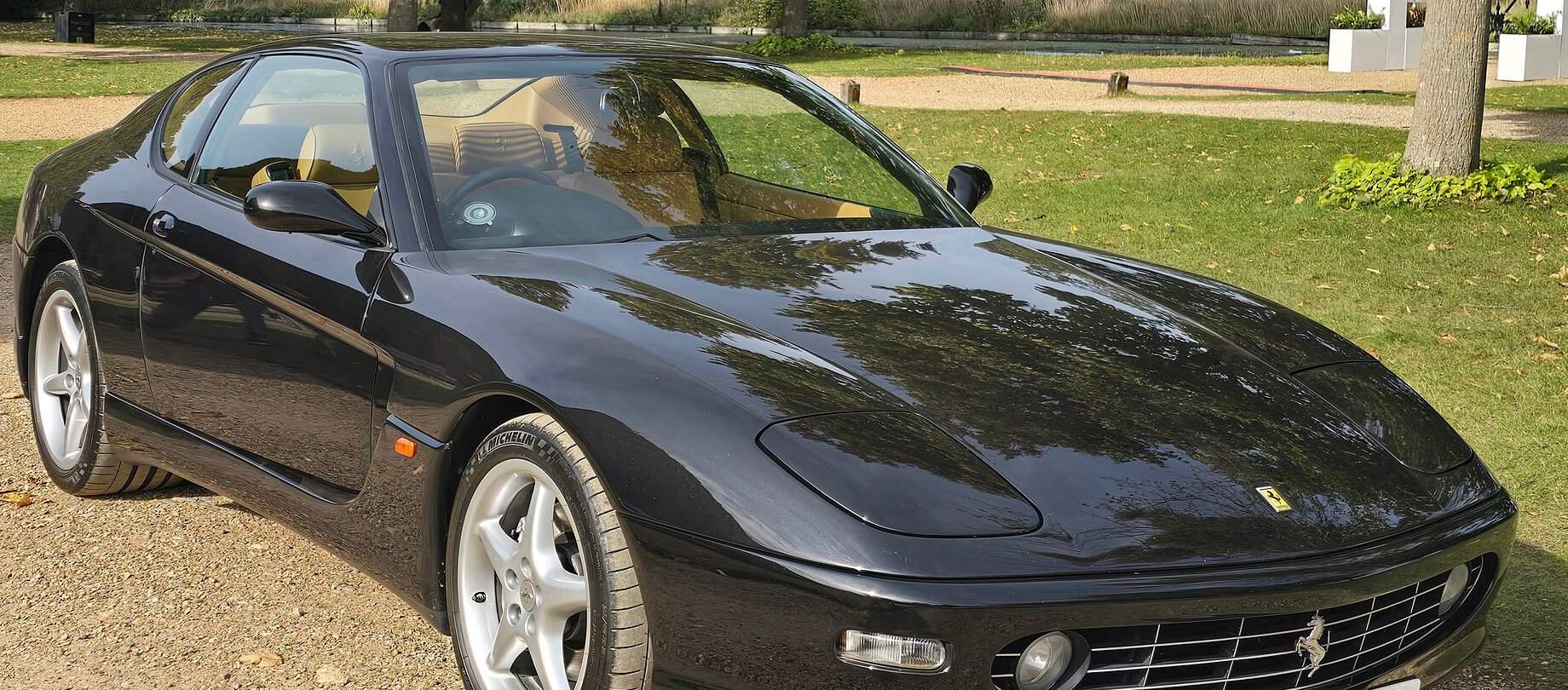
Front engine, twelve cylinders, rear drive, a gated six-speed manual and Pininfarina bodywork. That description covers two Ferraris built within four years of each other, and one of them costs twice what the other does.
The 550 Maranello is £120,000 and rising. The 456 GT is £60,000 and barely moving. They share an era, a layout and an engine configuration. What separates them is that the 456 has a back seat and the 550 does not.
The two-seat rule
Line up the front-engined V12 Ferraris of the modern era and the sorting is almost embarrassingly clean. Every two-seat car sits above every 2+2, regardless of age, power or how good it is to drive.
What a back seat costs
Front-engined V12 Ferrari guide values, August 2026. Gold bars are strict two-seaters; blue bars are 2+2s.
The 456 is the anomaly worth staring at. It is a V12 Ferrari with a gated manual gearbox — the thing the entire market has spent five years deciding it wants — and it is the cheapest way to own one by a wide margin.
Every other manual V12 Ferrari has been discovered. The 456 is the last one still pretending to be ordinary.
Why it has been left behind
Partly the shape. The 456 is beautiful in a restrained, almost anonymous way — it looks like a large coupé rather than a Ferrari, which was the point in 1992 and is a liability now. A 550 announces itself. A 456 does not.
Partly the seats. A 2+2 reads as a compromise even to buyers who will never carry anyone in the back, and the market treats compromise as a discount. We found exactly the same pattern on the E-Type, where the 2+2 is £45,000 against £110,000 for the two-seat roadster of the same year. Nine inches of wheelbase, two thirds of the value.
And partly the automatic. Roughly half of these cars are GTAs, and at £40,000 they drag the model's reputation down with them. Buyers see "456" in the classifieds at forty thousand and assume that is the car. It is not — it is the other one.
The warning on the same chart
Before treating this as a straightforward buy, look at the 612 Scaglietti. It is the 456's replacement, it is also a V12 2+2, and it is the only car on that chart with a negative trend — minus two per cent a year while everything around it climbs.
Being a V12 Ferrari is not, on its own, an investment thesis. The 612 has an F1 paddle gearbox on most cars and aluminium construction that makes repairs expensive, and the market has priced both. The 456's case rests on the manual gearbox specifically — take that away and it looks a lot like the 612.
So?
If you want a manual V12 Ferrari and £120,000 is not available, the 456 GT is the answer and there is no close second. You are buying the same fundamental experience as the 550 with a longer roof and a pair of seats you can ignore.
What you are not buying is a cheap Ferrari. Cambelts, clutches and the electrics on a nineties Maranello car do not care what you paid, and the gap between a £60,000 example and a £35,000 one is usually the bill that is coming. On these, the service history is the asset.