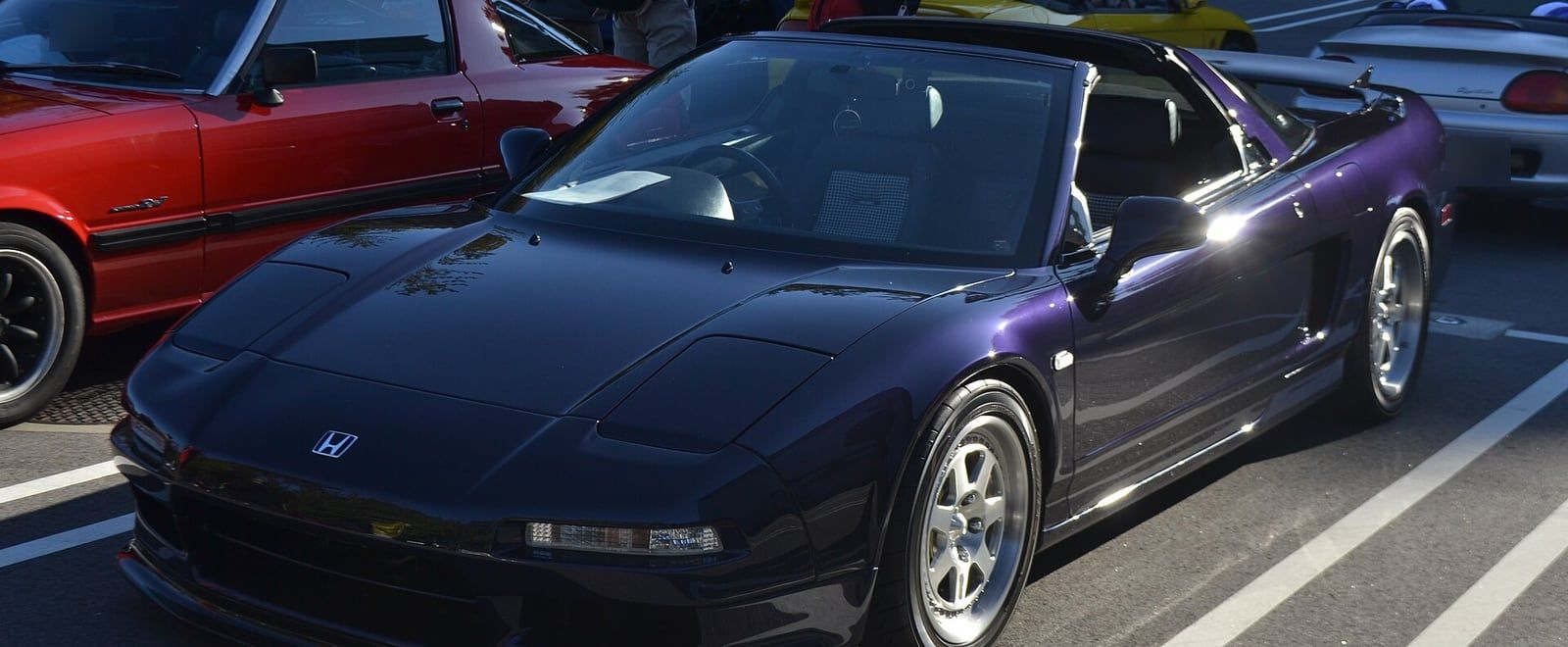
The NSX is the rare supercar people buy to use. Autocar once counted fewer than 300 in the UK and found four of the 23 on sale had passed 100,000 miles, which tells you how owners treat them. It also explains why the price ladder looks the way it does: a good early car is valued at £85,000, a later NA2 at £110,000, and the original Type R at £320,000, nearly four times the price of the car it was built from.
Those three numbers answer two different questions. The gap between the NA1 and the NA2 is about how the car drives and how it has been looked after. The gap to the Type R is about rarity, and about a Japanese-market specification most buyers will never see on a British road.
One shape, fifteen years
Honda launched the NSX in 1990 with the first all-aluminium monocoque in series production, which saved roughly 200 kg over steel, and a 3.0-litre VTEC V6 behind the seats. The brief was to match Ferrari's V8 cars and beat them on reliability. Ayrton Senna drove prototypes at Suzuka during Honda's Formula 1 years, and the body was stiffened after his feedback. The result was a mid-engined car you could drive to work, which is the reputation it still trades on.
It changed slowly. The targa-roofed NSX-T arrived in 1995, with extra bracing to make up for the missing roof. In 1997 the manual cars received a 3.2-litre engine and a six-speed gearbox, and those are the cars collectors call NA2. In 2002 the pop-up headlamps gave way to fixed xenon units. Production ended in 2005 after more than 18,000 cars worldwide, a small number for a car on sale for fifteen years.
The first-generation NSX, standard cars and Type Rs
Honda NSX guide values, October 2026, for good, documented cars.
NA1 or NA2: what the extra money buys
The names cause confusion, so it is worth being precise. NA1 and NA2 describe the engine, not the headlamps. An NA2 is a manual car from 1997 on with the 3.2-litre C32B, which raised output from 274 PS to 294 PS, and the six-speed gearbox with closer ratios. The automatic cars kept the 3.0-litre engine and the NA1 code until production ended in 2005, so a late automatic is still an NA1 under the skin.
That is the first thing the extra money buys: the stronger engine and the better gearbox, in cars that are on average younger and have had fewer years to be neglected. The second thing is the 2002 facelift for buyers who want it. The fixed headlamps divide opinion, and plenty of collectors prefer the pop-ups of the earlier cars, but the facelifted cars are the last of the line. In Britain the most sought after are the final cars Honda imported in 2005: RM Sotheby's described one it offered as one of the last twelve UK-supplied NA2s, with an estimate of £100,000 to £125,000.
The Type R: a different market
The original Type R was built from late 1992 for Japan only, and 483 were made. Honda took out the sound deadening, the audio system, the spare wheel and the air conditioning, fitted carbon-kevlar Recaro seats and lighter wheels, and reworked the suspension, saving about 120 kg. The 2002 NSX-R went further, with a carbon bonnet, hand-assembled engines and no power steering, and it was again sold only in Japan.
The step to an NA2 buys a better car to drive. The step to a Type R buys scarcity.
None of that makes a Type R four times the car on a British B-road. What it buys is scarcity, a specification that started a famous line of Hondas, and a buyer base that is global rather than local. That is why these cars are priced by a handful of auctions in Japan and America rather than by British classifieds, and why the gap to the standard car can move sharply in either direction. A Type R is a collector's purchase. Buy one for the history and the provenance, not for the lap times.
Which one to buy
For most buyers the choice is between a manual NA1 coupé and a manual NA2, and the deciding question is condition, not generation. Autocar's buying guide is clear on what to check: the timing belt and water pump every seven years or 70,000 miles, the gearbox countershaft bearing on early five-speed cars, and the body, because aluminium is hard to repair and repaint well. On later cars, the fixed headlamps are expensive to replace. A documented NA1 that has had its belts done will be a better buy than a tired NA2 that has not.
If you want the best NSX to drive, the NA2 manual coupé is the one, and its premium over a good NA1 is a fair price for the engine and gearbox. If you want the purest form of the original idea, an early pop-up coupé makes the stronger case. Either way, it is a car that rewards being used, as the Skyline GT-R ladder shows for its rival from the same era: in this market, condition and history move the price as much as the badge.