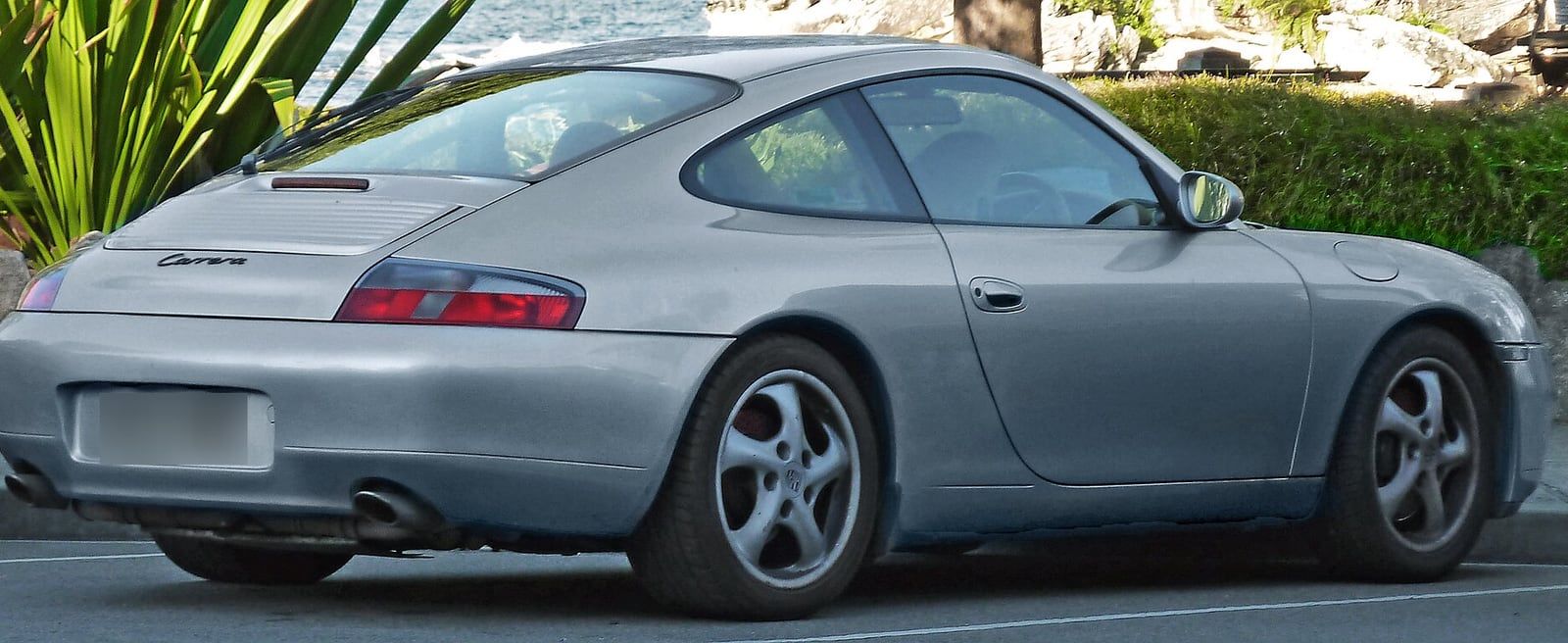
When the 996 arrived in 1997 it was the most radical 911 Porsche had built: the first with a water-cooled engine, and the first on an all-new platform since the original car. A good part of the 911's following never forgave it. That is why it is now the cheapest way into a 911. A good 996 Carrera is valued at £25,000 on our 996 Carrera page, against £33,000 for the 997 Carrera that replaced it and £68,000 for the air-cooled 993 Carrera before it.
Three things hold the price down. The first is numbers: Porsche built 175,262 cars of the 996 generation, Turbos and GT cars included, between 1997 and 2005. The second is the Boxster. The two were developed together to save money, and the 996 shared interior parts and its engine family with the cheaper roadster, as well as the amber-lensed "fried egg" headlamps that made the two cars look alike from the front. The third is the engine, and it is the one that matters to a buyer.
None of this makes the 996 a lesser 911 to drive. It is rear-engined, flat-six and built in Stuttgart, and its multi-link rear suspension and six-speed manual gearbox were carried over, revised, from the 993. The question for a buyer is not whether the 996 is a real 911. It is which 996, and how much is known about its engine.
What the money buys
The first Carreras had a 3.4-litre engine of 300 PS. In 2002 the car was facelifted: the engine grew to 3.6 litres and 320 PS, and the headlamps were redesigned along the lines of the Turbo's, after owners complained that their 911 looked too much like a Boxster. The same year brought the Targa, with a sliding glass roof, and the wide-bodied Carrera 4S, which borrowed the Turbo's body, brakes and suspension. For the 2004 model year there was a 40th Anniversary Edition with the Turbo's nose, 345 PS and GT Silver paint only; Porsche built 1,963 of them, one for each year since the 911's launch.
Our 996 Carrera value is for a good, usable car, and the range around it is wide. The values in our 996 guide put the facelifted 3.6-litre cars above the early 3.4s, manuals above Tiptronic automatics, and coupés ahead of the open cars for collector interest. Rear-drive or four-wheel drive is largely a matter of taste: Magneto's buying guide calls the choice an entirely personal one. What moves a 996 most, though, is not any of these. It is evidence.
The engine question
The intermediate shaft bearing, the IMS, is the 996's famous weakness. If it fails it can take the engine with it. It was the subject of a class action, in which failure rates of up to 8% were disclosed, and Magneto puts the rate for cars made between 2000 and 2005 at around eight per cent. It affects the Carrera and Carrera 4 engines only: the Turbo, GT2 and GT3 use the older Mezger-designed engine and do not have the problem. A retrofit is available and well proven, and both Parkers and Magneto advise looking for a car where it has already been done, by a reputable specialist, with the paperwork to show it.
There is a second risk, less famous and in some ways harder to see. Bore scoring, damage to the cylinder walls, is relatively rare, but it is hard to spot without specialist equipment and expensive when it happens, so Magneto recommends a borescope inspection before buying. Weeping rear main seals are common too: the part is cheap, the labour is not. And the radiators sit behind the front air intakes, where leaves and mud collect and rot them from the inside. A buyer should look.
With a 996 you are buying the engine's history as much as the car.
The two engine risks pull in opposite directions, which is why no model year is safe on its own. The earliest cars, from the 1998 model year, used a dual-row IMS bearing, and failures on them are very rare. But Magneto finds the early 3.4-litre engines much more prone to bore scoring than the 3.6-litre engines that came after 2001. The facelifted cars, the ones the market prefers, fall inside the 2000 to 2005 window that Magneto's eight per cent covers. So the answer is not a year. It is a car with a documented bearing retrofit, a clean borescope report and a service history from a specialist who checks the oil filter for metal at every change.
Is it a good buy?
For someone who wants a 911 to drive, yes. Nothing else gives as much of the real thing for the money, and a well-documented car with the bearing done is a much better proposition than its price suggests. The buyer who wants none of the engine worry has an alternative within the same generation: the 996 Turbo, valued at £42,000, uses the Mezger engine and avoids the IMS question altogether. We wrote about what to check on that engine in a separate piece.
The limit is the same one that keeps the price low. With so many cars built, there is no shortage to push values up quickly, and the air-cooled 993 still costs more than twice as much (why is in our piece on the 993). A 996 is a car to buy because you want to drive a 911. That a good one should hold its value is a bonus, not the reason. And the cheapest 996 on the market, with no history and no record of the bearing, is rarely the cheapest one to own.
The 996 Carrera page carries the current value and a free check for any asking price. Our 996 guide covers every version of the car: the IMS question in full, the versions to buy, what to check and what each is worth.