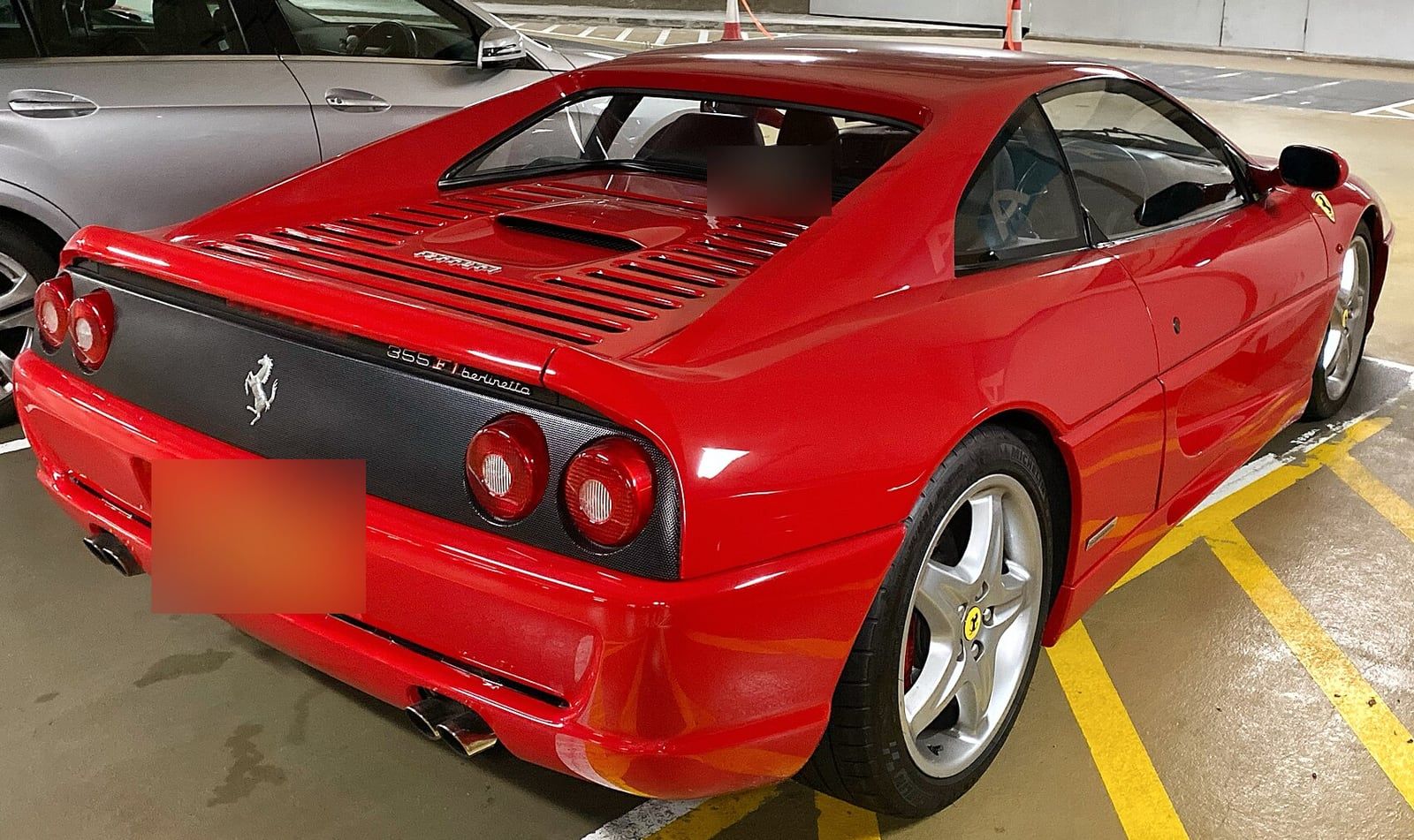
For its first three years the F355 came one way: a 3.5-litre V8 with five valves per cylinder, and a six-speed manual working through Ferrari’s open metal gate. In 1997 the Berlinetta became the first road car fitted with an F1-style paddle-shift gearbox, a system Ferrari had first raced in 1989. The Spider and the targa-topped GTS offered it too, and the cars so equipped were badged 355 F1.
Buyers of the day were in no doubt. evo’s Peter Tomalin, who tested the car in the UK, recalls that very soon more than half of orders were for the paddle-shift car, despite it costing £6,345 more. It was the future, and for once the future was available at a Ferrari dealer before anywhere else.
Nearly thirty years on, the market has reversed the verdict. The question for anyone shopping for an F355 now is whether the manual’s premium is a fact of life to be paid, or a fashion that a patient buyer can step around.
What the gate is worth
The Classic Valuer, which tracks public sales, splits F355s by gearbox where the listing allows it. Since 2020 its manual Berlinettas have sold for a median of £108,517 across 88 sales. Every other Berlinetta it records has sold for a median of £75,818 across 71. That is a gap of about £33,000, or roughly 43 per cent, on what is otherwise the same car.
F355 Berlinetta sold prices by gearbox
Median sold prices since 2020, from The Classic Valuer, October 2026. The gold bar is Berlinettas listed as manuals; the blue bar is every other Berlinetta.
UK dealer pricing tells the same story from the other end. evo puts the cheapest way into a 355 at an F1 Spider, from around £70k, and a low-mileage F1 coupé at upwards of £80k. A three-pedal Spider leaves little change from £100k, the GTS costs more again, and manual coupés start at £130k. Our own catalogue values a good, usable 355 Berlinetta at £90,000 and an F355 Spider at £80,000, either gearbox, which is where the two kinds of car meet in the middle.
The manual premium is not a scarcity premium. Ferrari built more than three manual F355s for every F1.
Why the gap exists
It is not rarity. Of 4,871 road-going Berlinettas, 3,829 were manuals and 1,042 F1s. The GTS split 2,048 to 529, the Spider 2,664 to 1,053. Across the three bodies the manual outnumbers the F1 by more than three to one, partly because the paddles arrived only in 1997. If supply set the price, the F1 would be the dear one.
Nor is it the hardware underneath. evo’s buying guide points out that manual or F1, it is the same six-speed gearbox; the F1 adds electro-hydraulic actuation of a single dry clutch. That first-generation system was a landmark, and it brings its own running costs: the actuators sometimes need replacing on higher-mileage cars, and a clutch costs around £1,300.
What the market is paying for is the gate. The F355 launched as a manual-only car, and for buyers who grew up with it, the polished gate and the gear lever moving through it are the reason to own one. The same pattern runs through the collector market: we found something similar with the 997 Turbo’s manual premium. A rare body or a famous engine can justify a premium on its own. A gearbox justifies one only for as long as buyers keep wanting to change gear themselves, and so far they show no sign of stopping.
The service that matters more
Whichever gearbox you choose, the number that will move the price most is a date: the last belt change. Ferrari specialist Foskers told evo the flat-plane-crank V8 gives very few issues provided it is serviced on schedule, which means an oil change every year and belts every three. CAR magazine’s guide gives the interval as every 31,250 miles or three years, whichever comes first, and notes that the engine has to come out to do the job properly.
Some specialists will change the belts with the engine in place for less. Foskers recommends removal anyway, because it lets the mechanic spot oil and water leaks and check the steel subframe. Either way, belts age with time, not miles. A car that has covered very little but has old belts is a car with a large bill attached, and the market prices it that way.
Two more things separate one F355 from the next. Early cars suffered premature valve-guide wear; evo reports that in most cases the guides were replaced with a later type, so the paperwork showing it was done is worth having. And the exhaust manifolds crack, which makes the car run hot and can burn out valves; replacing both costs around £3,000. evo’s specialists do a compression check and a leakdown test on every car they look at.
So which?
If you are buying an F355 partly as somewhere to keep money, buy a manual and accept the premium. The gap is wide in the sales data, it is what the next buyer will ask for, and manual coupés and GTSs sit at the top of evo’s price range for that reason.
If you want to drive an F355 for the least money, the F1 is the honest answer, and the F1 Spider is the cheapest of all. You get the same engine, the same chassis and the same noise for tens of thousands less. Go in knowing it is unlikely to close the gap on the manual, and budget for the actuators and clutch as well as the belts.
Either way, buy the history before the gearbox. A well-documented F1 with fresh belts is a better purchase than a manual whose belts are overdue, and the difference shows up when you sell. How to read that history, from belt invoices to valve-guide evidence, is a job for the guide below, not for this article.