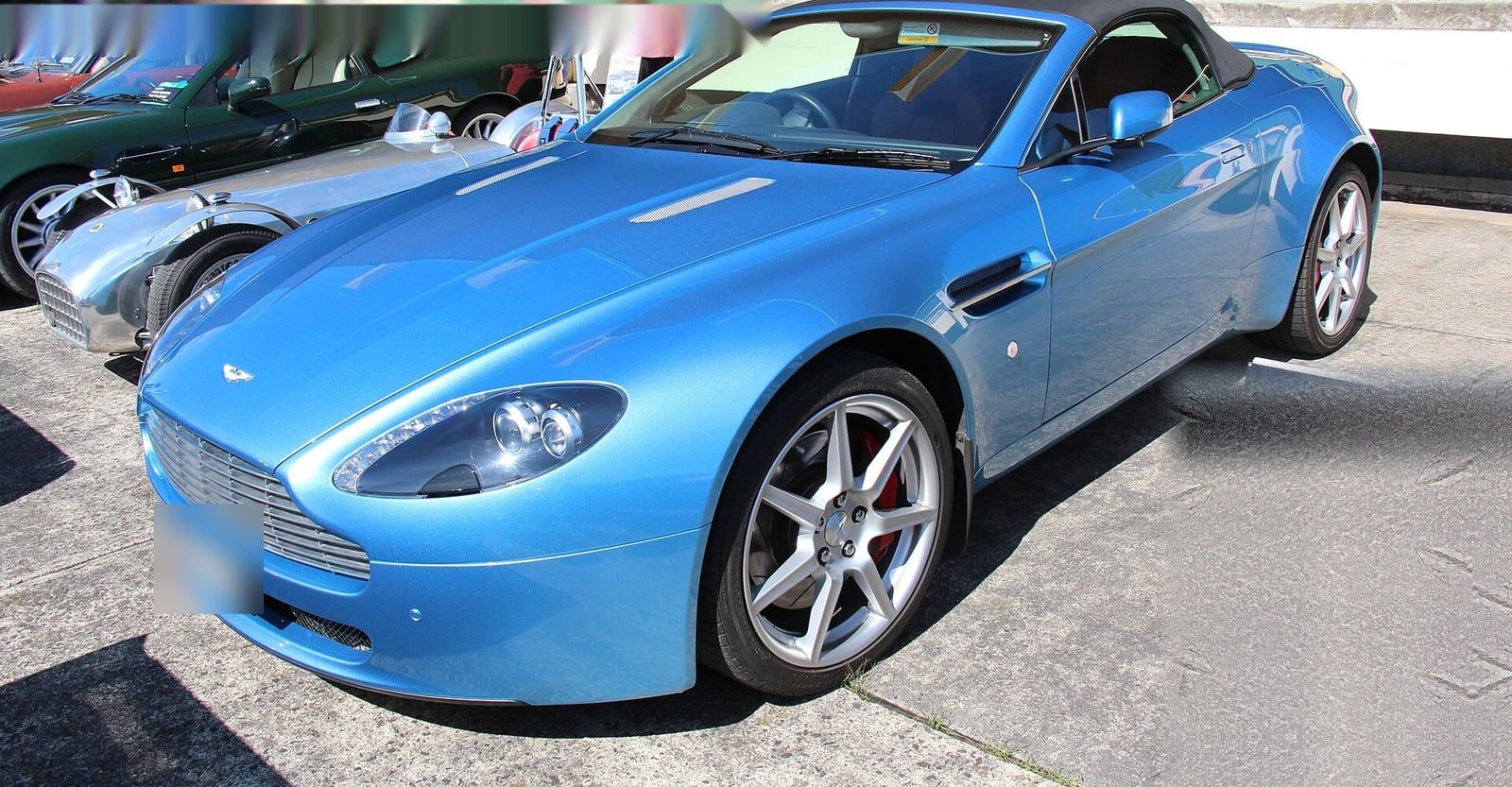
Aston Martin showed the production V8 Vantage at the Geneva Motor Show in 2005, and built it at Gaydon until 2017. Over those years it became the most successful model in the company's history. That success is the reason it is now the cheapest way into a modern Aston: a good V8 Vantage is valued at £32,000 on our V8 Vantage page, about what a DB9 costs at £30,000, and less than a third of the V12 Vantage at £100,000.
It was meant to sell in numbers. The car began as the AMV8 Vantage concept, shown at the Detroit motor show in 2003, and the production version was aimed squarely at the Porsche 911 rather than at the grand tourers Aston had built before. It was a smaller car than the DB9, built to be driven hard, and it sold in larger numbers than any Aston before it. That is why there are so many on the market today.
Volume keeps the price down, and it also keeps the choice wide. There were coupés and roadsters, 4.3-litre and 4.7-litre engines, a manual gearbox and an automated one, and a long run of special editions. For a buyer with £30,000 to spend, that variety is the whole story: two V8 Vantages of the same year can be very different cars to own.
What the money buys
The first cars used a 4.3-litre V8 of 380 bhp. The engine shared its basic architecture with Jaguar's AJ-V8 but was Aston Martin's own, hand-built in Cologne and dry-sumped so it could sit low in the chassis. From 2008 it grew to 4.7 litres and 420 bhp. The body is bonded aluminium, the gearbox sits at the back in a transaxle, and the weight is split almost evenly between the axles. It is a small, light car by Aston standards, designed for driving rather than touring.
The market reads the range in a fairly simple way. Autocar's used buying guide puts the early 4.3-litre coupés, mostly manuals, at £29,000 to £34,995, around our value, with the later 4.7-litre cars from about £42,000. The special editions cost more again: the N400, a 2007 limited edition built to mark Aston's racing at the Nürburgring, with its 4.3-litre engine tuned to 400 bhp, is valued at £45,000. The N420 that followed in 2010 was based on the 4.7 and offered with either gearbox.
Between the two engines the choice is less clear-cut than the price suggests. The 4.7 has more power and more torque, and the market pays for it. The 4.3 is the original car, the engine the Vantage was launched with, and the choice for a buyer who wants it as it first was. Either is a good car. Which one is better value depends on the gearbox behind it.
The gearbox is the decision
A six-speed Graziano manual was standard. The alternative was Sportshift, an automated manual: the same kind of gearbox with the clutch and the changes worked by the car. On a new car it was a convenience. On a fifteen-year-old car it is a cost. Its actuators and clutch need specialist attention as they age, and the buyers these cars now appeal to mostly want to change gear themselves.
Our view, and the values in our Aston Martin guide, put the manual ahead. We have not seen a reliable public figure for how far ahead, and asking prices vary too widely to give one. But the direction is not in doubt. A Sportshift car that looks cheap against a manual is usually cheap for a reason, and whatever it saves at purchase it can give back in a single clutch job.
There is a wrinkle. From 2011 the more powerful Vantage S was launched with a seven-speed Sportshift II, and in the 2012 model-year update Sportshift II replaced the older six-speed unit across the range. It is a better gearbox than the first Sportshift. So "automated" does not mean the same thing on every car: a late car with Sportshift II is a different proposition from an early six-speed automated car, and both are different again from a manual.
With the manual it is a sports car at a bargain price. With the early automated gearbox it is a cheaper car with a running cost attached.
The case, and its limits
The case for the V8 Vantage is that it is better than its price. It is a driver's car, it looks as good as anything Aston has made since, and a well-kept manual costs about as much as a new family hatchback. Nothing else in the range offers as much car for the money.
The limit is the same volume that makes it cheap. With so many cars built, there is no shortage to push prices up. Our value has moved slowly, and the cars that have done best are the specific ones: manual, well documented, in the right colours, or one of the special editions. A V8 Vantage is a car to buy because you want to drive it. That it should hold its value better than most modern cars is a bonus, not the reason.
The V8 Vantage page carries the current value and a free check for any asking price. Our Aston Martin guide covers the V8 Vantage alongside the DB7, DB9, Vanquish and DBS: the version to buy, the faults to check and what each configuration is worth.