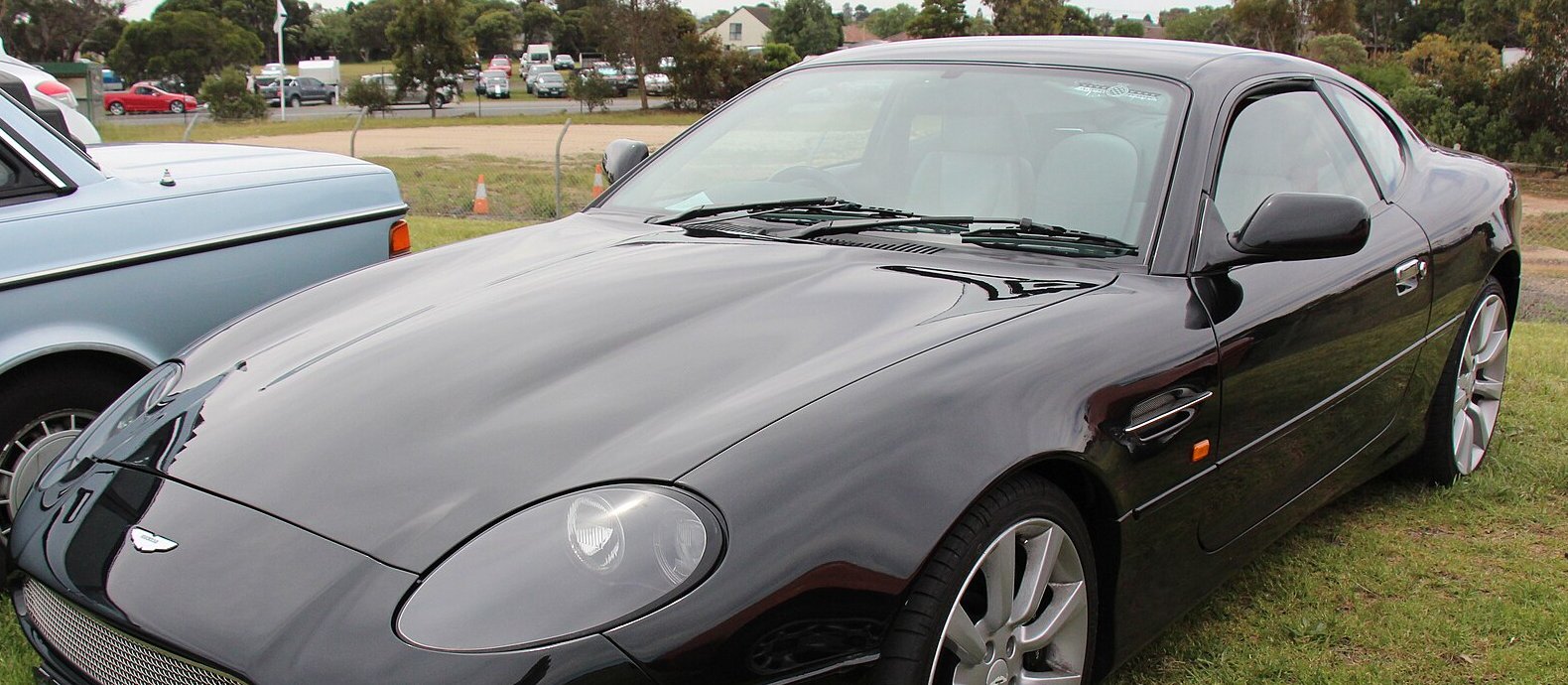
The DB7 is the car that saved Aston Martin, and it is currently the cheapest way into the marque by a wide margin. That much is well known. What is less well known is that there are two entirely different cars wearing the badge, they look almost identical, and the market prices them about six thousand pounds apart.
That gap is far too small, and it is the clearest mispricing we can find anywhere in the Gaydon era.
Two cars, one shape
The original DB7, from 1994, uses a supercharged 3.2-litre straight-six. It is a Ford-era engine in a Ford-era car, built when Aston Martin had no money and needed a product it could actually sell in volume. It worked — it kept the company alive — but nobody has ever called it the best part of the car.
The DB7 Vantage of 1999 kept the body and replaced the engine with an all-new 5.9-litre V12. Different performance, different noise, and materially better reliability. From ten feet away, and to almost every buyer scrolling classifieds, it is the same car.
The Gaydon era, cheapest first
Aston Martin guide values, August 2026. Gold bars are the V12 cars; blue are the six-cylinder DB7s and the V8 Vantage.
Read the two DB7 rows again. Thirty-two thousand for the six, thirty-eight for the V12. Six thousand pounds is a set of tyres and a service on a car at this level — and it is the entire difference between the engine Aston Martin could afford and the engine it actually wanted to build.
The V12 is not a more expensive version of the six. It is the car the six was standing in for.
Why the market has not sorted it out
Because they look the same, and because almost nobody is shopping by engine at this price. A buyer searching for a DB7 sees a list running from about eighteen to about forty thousand and reasonably assumes it is a condition spread. It is not — it is two different cars interleaved.
The automatic six at £18,000 makes it worse. It is the cheapest Aston Martin on the market and it anchors what everyone thinks a DB7 costs, dragging the whole model down with it. It is also the only car on that chart going nowhere: flat, against +4% a year for the V12.
The wider point about Gaydon
The whole era is cheap. A V12 Vanquish — a carbon-fibre-monocoque flagship that cost more than a house when new — is £65,000. A DB9 is £50,000. These were the most expensive cars Aston Martin made, and they now sit at money that buys a mid-range new SUV.
Partly that is because there is no scarcity story here. Nothing in the Gaydon range had its number fixed by a rulebook the way the E30 M3 did, or had a category close around it like the 993. Aston Martin built these to sell as many as it could, and it did.
Strictly, only half of them are Gaydon cars at all. The DB7 was built at Bloxham and the Vanquish at Newport Pagnell, and the factory the era is named after did not open until 2003. But the range is one continuous product of Ford’s ownership, and the market prices it as one thing.
The range, car by car
DB7 · 1994 · £32,000. Built at Bloxham on a heavily reworked Jaguar XJS platform, with a supercharged 3.2-litre straight-six making 335bhp. Ford paid for it and Ian Callum drew it, and Aston Martin sold more DB7s than every DB-badged car before it combined. Whatever else it is, it is the reason there was a company left to have a modern era.
DB7 Vantage · 1999 · £38,000. The same body with an all-new 5.9-litre V12 making 420bhp. Quicker, far better sounding, materially more reliable — for six thousand pounds more. This is the car the rest of the article is about.
V12 Vanquish · 2001 · £65,000. A bonded aluminium and carbon-fibre structure engineered with Lotus, 460bhp, and paddles where the gearlever should be. It was also the last car built at Newport Pagnell, in 2007, closing fifty years of Aston Martins leaving that works. The gearbox is the thing to understand before buying one.
DB9 · 2004 · £50,000. The first car out of the new Gaydon factory and the first on the VH architecture that carried Aston Martin for the next fifteen years. 5.9 V12, 450bhp, a Henrik Fisker shape that has not dated. Early cars run at +4% a year.
V8 Vantage · 2005 · £47,000. The volume car, and the one that made the factory pay: 4.3 litres and 380bhp at launch, 4.7 and 420bhp from 2008. The manual 4.7 has the strongest trend in the range at +5% a year. The Sportshift version is £29,000 and flat.
DBS · 2007 · £80,000. The flagship and the end of the era: 510bhp, carbon-fibre body panels, carbon-ceramic brakes, and a car Aston Martin handed to Bond a year before anyone could buy one.
The argument against
Cheap Aston Martins are cheap for a reason, and it is not the purchase price that gets people. These are complex, low-volume cars with expensive parts and a small specialist network. A Vanquish gearbox is its own subject, and the gap between a good example and a bad one is a five-figure sum you find out about later.
So this is not a buy-anything-with-the-badge argument. It is narrower: if you are buying a DB7 at all, taking the six to save six thousand pounds is the one decision on this chart that is clearly wrong.