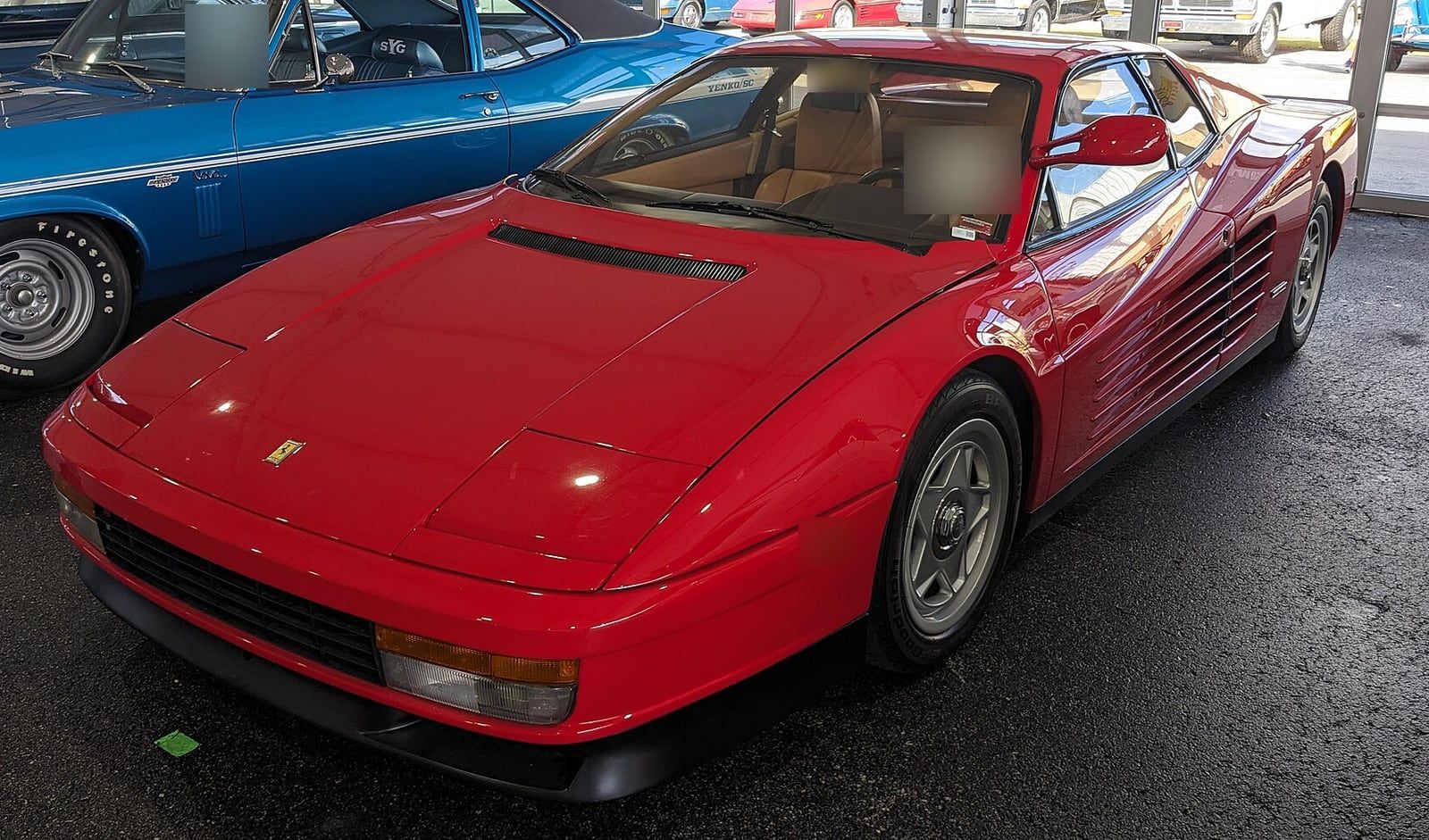
If one Ferrari stood for the 1980s, it was the Testarossa. It arrived in 1984 to replace the 512 BBi, and within two years it was being driven through Miami Vice and raced across arcade screens in Sega’s Out Run. Its side strakes were copied on everything from body kits to motorcycles. For a generation of buyers now in their fifties and sixties, this is the shape that went on the bedroom wall, alongside the Countach.
So it is a little surprising that the market’s money has gone elsewhere. Our catalogue values a good, usable Testarossa at £120,000. The 512 TR that replaced it in 1991, with the same flat-twelve, the same strakes and much the same profile, is valued at £200,000. That is two-thirds more for a car most people outside the Ferrari world could not tell apart from the original at fifty paces.
Is the premium a fair price for a better car, or a fashion a patient buyer can step around? The answer depends on which of the two things a Testarossa can be you are buying.
The gap, and the numbers behind it
Testarossa and 512 TR: guide values and production
AutoIndex guide values for good, usable UK cars, October 2026. Gold is the original Testarossa; blue is the revised 512 TR. Production from Wikipedia.
The obvious explanation is scarcity, and it is part of the story. Ferrari built 7,177 Testarossas between 1984 and 1991, a huge number for a twelve-cylinder flagship. The 512 TR ran for only three years, and Wikipedia counts 2,261 of them; Classic & Sports Car puts the figure at 2,280. Either way there is roughly one 512 TR for every three Testarossas.
For a British buyer the gap is starker still. Classic & Sports Car records 438 right-hand-drive Testarossas against just 88 right-hand-drive 512 TRs, 38 of them with ABS. A right-hand-drive 512 TR is a genuinely rare car in a way the Testarossa, for all its fame, never was.
Scarcity explains part of the gap. The rest is that Ferrari answered the Testarossa’s critics.
What Ferrari changed
The Testarossa was conceived as a grand tourer, not a racer. Its 4.9-litre flat-twelve made 390 PS in European form, it had air conditioning as standard, and it was designed to fix the 512 BBi’s faults, including a cabin that cooked its occupants. That is why the radiators moved from the nose to the flanks, feeding off the famous strakes. The result was fast and comfortable, but Classic & Sports Car notes that its handling and steering suited a grand tourer more than a hard-driven sports car.
The 512 TR was Ferrari’s reply. Higher compression, stronger engine castings, bigger inlet valves, revised camshafts and Bosch Motronic injection took the engine to 428 PS. Wikipedia gives 0–100 km/h in 4.8 seconds and a top speed of 195 mph. Classic & Sports Car’s verdict is blunt: the 512 TR responded far better when driven hard. The F512 M that followed in 1994 went further again, and with only 501 built it was the last Ferrari with a flat-twelve.
This is the same pattern we found with the 328 and the 308. Among cars that look alike, the market usually pays most for the developed version, the one where the factory had time to fix what the first owners complained about. The poster car is rarely the one that commands the money.
The case for the original
There is a serious case for the Testarossa, and it is not only the £80,000. The original is the car of the legend. The early cars, with Ferrari’s single high-mounted mirror on the driver’s side, are now known as monospecchio examples. In 1987 the mirror was lowered and a second one added, so a genuine single-mirror car is a specific, datable thing. For a buyer who wants the 1984 shape exactly as it appeared, no later car will do.
Nor is the original a cheap car pretending to be a dear one. Hagerty’s UK valuation guide has put an excellent Testarossa at £101,000, with concours examples reaching £175,000, so the very best originals come close to what a good 512 TR costs. The difference at that level is no longer quality; it is which car you would rather own.
And the running costs barely favour the later car. Both need the same discipline: an annual service whether or not the car moves, and every three years the engine comes out for new drive belts. Classic & Sports Car points out one difference that runs in the original’s favour. Up to 1991 the engine drops out underneath the car, but from the 512 TR onwards it has to come out of the top, which costs more.
So which?
If you want the car you remember, buy a Testarossa, and spend the difference on finding the right one. A well-documented European car with recent belt work is worth more to you than an extra fifty horsepower, and an early single-mirror car is the version that speaks most clearly of 1984. The original no longer looks like the cheap way into a flat-twelve Ferrari; it looks like the icon priced at a discount.
If you want to drive one hard, or you are thinking about what the car will be worth in ten years, the 512 TR has earned its premium. It is the better-sorted car, it was made in much smaller numbers, and in right-hand drive it is scarce enough that the next buyer will have few alternatives.
Either way, buy the history before the badge. A Testarossa with a complete service file is a better purchase than a 512 TR with gaps in it, and the engine-out bills make those gaps expensive. How to tell a genuine single-mirror car from a converted one, and how to read the service file, is the guide’s job, not this article’s.